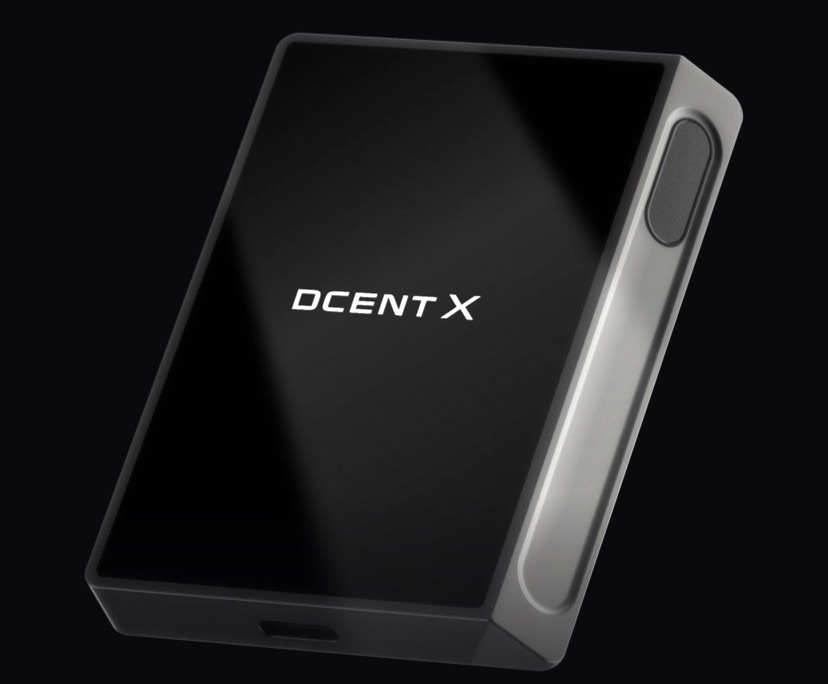
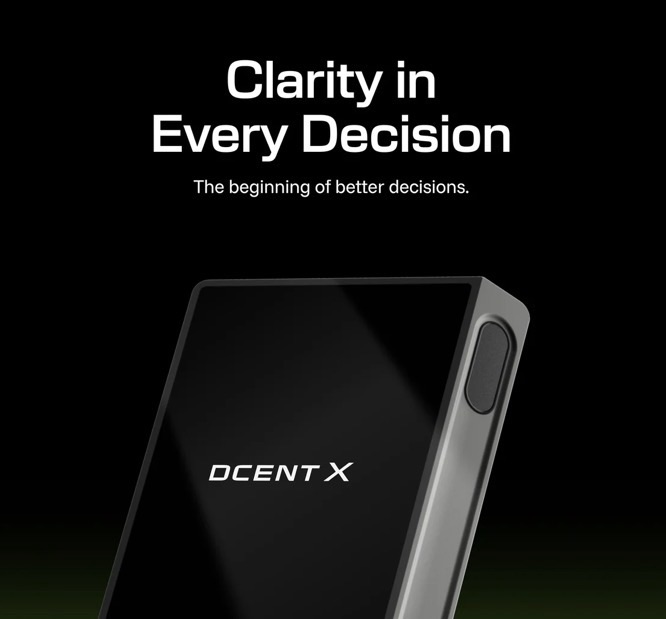
DCENT X is not a quiet mid-cycle refresh. It is the first device built entirely under the company’s new name, launched on the same day D’CENT dropped the apostrophe and restated its pitch as “beyond storage.” The official store lists it at $230, with pre-orders shipping from 30 September 2026. The tagline is unusually specific for a hardware wallet: “Clarity in every choice. See it clearly, transact with your fingerprint.”
That sentence is the whole product argument. Most hardware wallets already store keys offline. The harder problem, especially as DeFi, account abstraction, and multi-chain signing have grown messier, is whether you can read what you are about to sign. DCENT is betting that a 2.4-inch AMOLED touchscreen plus a fingerprint on the device itself is the answer.
This is a first look based on the official product page, specifications, and the brand announcement — not a long-term hands-on of a shipped retail unit. That distinction matters. Pre-order pages are always optimistic. What follows is what the company is actually putting on the table, and where that sits in a market already crowded with Ledger Stax/Flex, Trezor Safe devices, Keystone, Tangem, and DCENT’s own older biometric brick and S card.
Where X sits in the DCENT lineup
IoTrust, the South Korean firm behind the brand, has sold fingerprint hardware wallets since 2018 and now claims more than 1.5 million users across 220 countries, with zero reported secure-chip breaches in that period. Those figures are the company’s own. They are useful as a track record claim, not as an independent audit of the new device.
The current store makes the product split unusually clear:
- DCENT X ($230): handheld device with a color AMOLED touchscreen, fingerprint, Bluetooth 5.0 and USB-C. Positioned for long-term holders who still want the vault in their pocket.
- DCENT X + R3covery Card kit ($249): same device plus the tap-to-backup card.
- DCENT S + R3covery Card kit ($59): credit-card thin, IP69, NFC only, no screen, no battery. Confirmations live in the phone app. (Save $10)
- The older Biometric Wallet remains on sale around $109, with the familiar small OLED and physical buttons. (Save $10)
X is the premium handheld. S is the always-in-the-wallet card. The older biometric unit is the lineage product that made DCENT known, especially among XRP holders. If you already own that older brick, X is the first time the company has moved the same biometric idea onto a modern color touchscreen and an EAL6+ secure element.
The screen is the product
The specification that changes the daily feel is the display: a 2.4-inch AMOLED color touchscreen at 450×600, with four brightness levels. DCENT’s copy leans hard on nighttime readability — “2 a.m., crystal clear from bed” — which sounds like marketing until you remember how many people actually sign from a phone in a dark room and then squint at a 128-pixel monochrome panel.
The security reason for a large on-device screen has not changed since the first Ledger and Trezor debates: phones and PCs can be compromised. The last honest view of recipient, amount, and network has to live on hardware the attacker does not control. DCENT illustrates this with a send flow that shows type, truncated address, amount, and network on the device before the finger goes on the sensor. That is standard “what you see is what you sign” doctrine. The difference is that X tries to make that check comfortable instead of a chore on a tiny OLED with four buttons.
In industry terms, X is closer to Ledger Stax/Flex or Keystone 3 Pro than to a Nano S Plus. Those devices already argued that transaction complexity needs a real screen. DCENT is arriving late to the large-display race, but with the one feature those products generally do not put on the device itself: fingerprint approval.
Fingerprint as the signing key
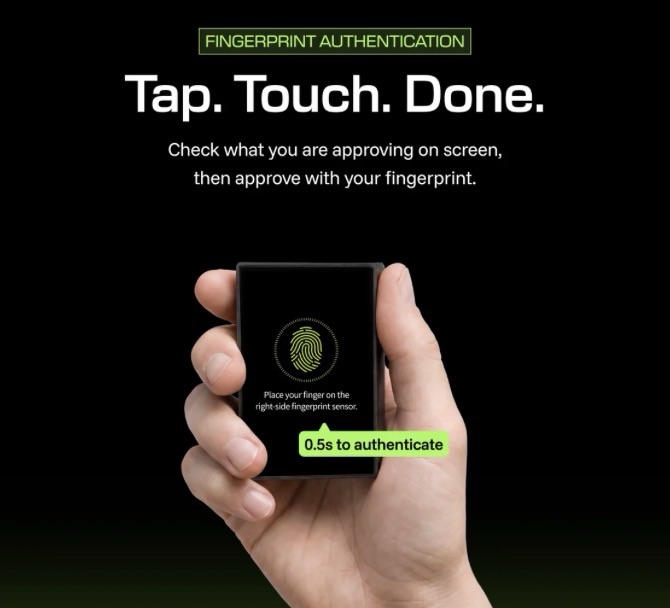
DCENT has treated fingerprint authentication as brand identity since 2018, when it launched what it still calls the world’s first fingerprint hardware wallet. On X the sensor sits on the right side of the device. Approval is specified at 0.5 seconds. You can register up to two fingerprints. A second print has the same authority as the first, including the ability to send coins, so the company correctly warns you to register it carefully. If biometrics are impractical, you delete the prints and fall back to a 4-to-8-digit PIN. Deleting one registered print removes both.
The more important claim is where the template lives. Fingerprint data is stored inside the same secure chip as the private keys. Device firmware, according to DCENT, cannot read it. It is not sent to a server. That is the right architecture if you are going to do biometrics on a hardware wallet at all. A fingerprint on the phone is just another software gate. A fingerprint bound to the secure element is closer to a physical possession factor that software cannot copy.
The marketing number — odds of two identical fingerprints at about 1 in 64 billion — is a biometric-industry talking point, not a wallet-specific security proof. What actually matters in practice is liveness, sensor quality, lockout policy, and whether an attacker with the device can fall back to PIN or extract the template. DCENT says repeated wrong PIN entries lock the chip, and that tampering or chip separation auto-locks or auto-wipes. Those are the policies to test once units ship.
My own view, after years of watching this category: fingerprint on-device is a genuine usability win for people who sign often and hate PIN entry. It is not a substitute for a well-kept seed. Anyone who can coerce the owner, or who finds an unlocked device with a registered second finger, still gets through. Treat it as strong convenience layered on a vault, not as magic.
Security stack: EAL6+, SecureOS, on-chip signing
X moves the handheld line up from the EAL5+ chips used on the classic biometric wallet to a Common Criteria EAL6+ certified secure element. That is the same evaluation class used in high-end payment and e-passport chips, and it matches the tier DCENT already advertised on some card products. EAL level is not a scoreboard of “unhackable.” It measures how rigorously the chip and its protection profile were evaluated against defined attack classes. Still, jumping from EAL5+ to EAL6+ on the flagship handheld is a real spec change, not a logo swap.
The rest of the stack is familiar cold-wallet doctrine, restated clearly:
- Private keys are generated offline inside the device, not imported from a phone or desktop wizard in a way that exposes them.
- Keys stay encrypted in the secure element.
- Signing happens on-chip.
- Bluetooth carries end-to-end encrypted traffic and, per DCENT, only public transaction data.
- Firmware authenticity is checked every time the device powers on.
- The device runs SecureOS™, a dedicated OS rather than a general-purpose one, which is the usual way to keep the attack surface small.
The four-layer summary on the product page is honest as a model even if it is marketing: secure element, dedicated OS, independent screen, fingerprint (or PIN) as the final gate. That is how a serious hardware wallet is supposed to look in 2026. What we do not yet have for X specifically is a published third-party firmware audit of this new board and OS revision. Older D’CENT firmware and applets were audited years ago; a new flagship deserves a fresh one. Until that exists, the company’s “zero breaches since 2018” claim is historical reputation, not a certificate for X.
One industry caveat is unavoidable: X is a Bluetooth 5.0 device with a battery and updatable firmware. That is a larger attack surface than an air-gapped QR wallet or a battery-free NFC card like DCENT S. Encrypted Bluetooth and on-chip signing mitigate the obvious risks. They do not make the radio disappear. Buyers who want maximum isolation will still prefer QR or NFC-only designs. Buyers who actually use the wallet weekly will accept the radio for the mobile workflow.
Recovery without the paper ritual
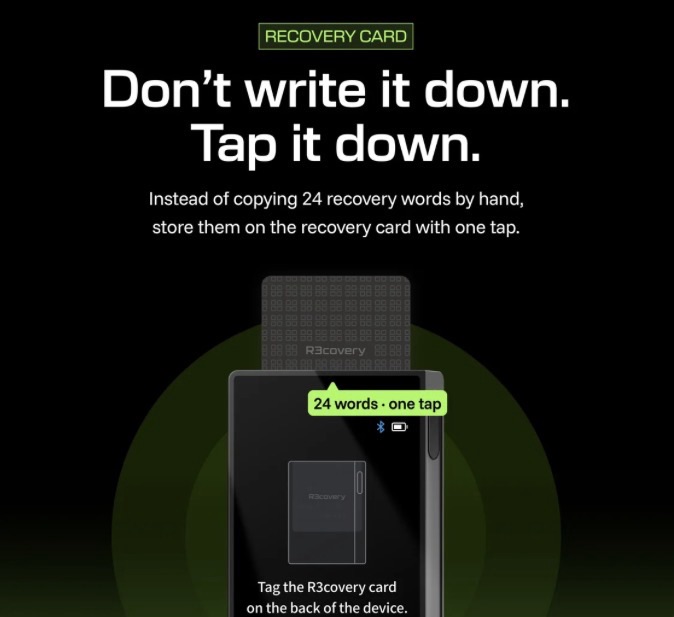
Seed handling is where hardware wallets usually lose beginners. X supports the standard 24 recovery words on paper. It also supports the R3covery Card: tap the card on the back of the device once and the words are stored on the card instead of being copied letter by letter. NFC on X is specified as R3covery card only, not as a general tap-to-sign interface. The card is included in the $249 kit and can be bought separately later.
This is a practical improvement. Paper fades, gets wet, and is easy to photograph. A dedicated backup card still has to be stored somewhere else — DCENT is explicit that device and recovery method must not live in the same drawer — but it removes the most error-prone part of setup. If you lose or break the X, assets remain on-chain; you restore on a new DCENT device from the words or the card. That is ordinary self-custody, explained without mystique.
I would still keep a metal or paper copy of the words in a second location. A recovery card is another object that can be lost, cloned if the protection is weak, or destroyed. Diversity of backup media is boring and correct.
One-Time Passphrase Wallets
This is the feature that feels most “2026” and least like a spec-sheet checkbox. X can create a one-time passphrase wallet that exists until the device powers off. Enter the same passphrase later and it can be used again; otherwise it vanishes without touching the main seed’s accounts. DCENT frames it as a way to try new services without putting the main stack at risk.
Functionally this is a disposable, passphrase-derived vault with a short lifetime on the device. That is useful for minting, airdrop wallets, unknown dApps, or any signing you would rather not perform from the account that holds the rent money. It is not a replacement for a well-designed 25th-word / BIP39 passphrase scheme on the main wallet, and the product page does not claim it is. Think of it as a clean-room mode. If the implementation is strict about wiping state at power-off, it is one of the more adult features in this launch.
Power, connectivity, and the “drawer” problem
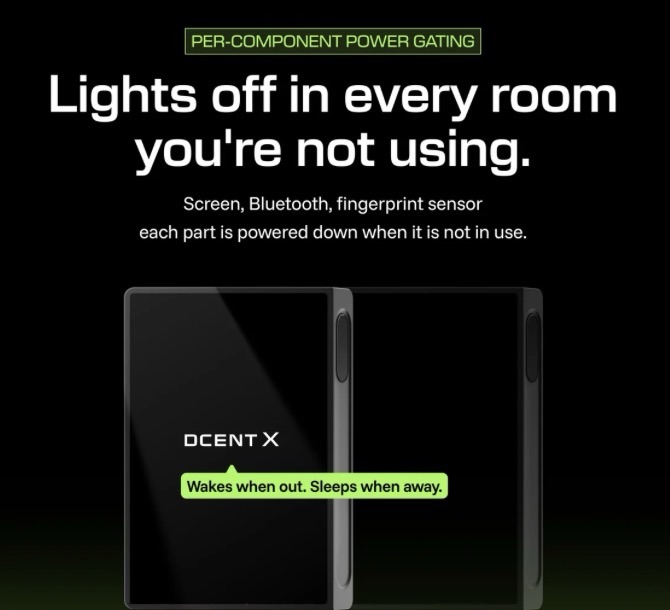
X has a built-in battery, USB-C charging, and what DCENT calls per-component power gating: screen, Bluetooth, and fingerprint sensor can be powered down independently. The pitch is that the device can sit in a drawer for weeks and still wake when you pick it up. Battery capacity in mAh is not listed on the X product page, unlike the 530 mAh figure published for the older biometric model. Until units ship, treat endurance as a claim, not a measurement.
Connectivity is Bluetooth 5.0 by default for app pairing, plus USB-C. That is a step up from BLE 4.1 on the previous handheld. Pairing is through the DCENT mobile app, which remains the control plane for account creation, portfolio, and most day-to-day management. In the box: the device, a USB-C to USB-C cable, packaging, and the R3covery card only if you bought the kit.
Warranty is one year with in-house support. Returns are 14 days if unopened. Shipping is free over $149, with duties and taxes included for the US, UK/EU, and Japan on the current store copy. Those commercial terms are cleaner than many hardware-wallet shops that surprise buyers with import fees.
Coins, chains, and the XRP shadow
Support is listed as 10,000+ coins and tokens across 100+ networks, with weekly additions from user requests. That breadth has been DCENT’s second identity after fingerprints. Bitcoin, Ethereum and EVM chains, Solana, XRP/XRPL, and a long tail of networks the bigger Western brands sometimes add slowly are the reason many users already live in the DCENT app. Exact coverage still has to be checked on the official supported-asset list before you move a niche token.
The store banners X as “Made for XRP holders” and points to an XRP Alliance with campaigns and rewards. That is not a technical limitation — X is a multi-chain device — but it is honest marketing. DCENT spent years becoming one of the default self-custody options in the XRP community: native accounts, in-app XRPL tools, and a culture of keeping keys off exchanges. X inherits that audience and tries to give it a screen worthy of reading every memo and destination tag.
If you are buying only for Bitcoin and want an air-gapped, partly open-source stack, this is not the most ideological choice. If you hold XRP plus a basket of EVM and alt L1 assets and already like the DCENT app, X is the first time that ecosystem gets a flagship display.
How it compares, without the fan chart
Versus the old DCENT Biometric Wallet. The old unit is a 36-gram plastic brick with a small OLED, physical buttons, BLE 4.1, and an EAL5+ chip. X replaces that interface with a color touchscreen, Bluetooth 5.0, EAL6+, one-time passphrase wallets, and NFC backup. Price jumps from the discounted ~$109 range to $230. That is a lot of money for an upgrade if you only send occasionally. It is easier to justify if you sign often and hate the four-button dance.
Versus DCENT S. S is cheaper, thinner, waterproof, and battery-free. It is also blind: you confirm on the phone. That is fine for small, frequent payments if you trust the phone session. It is the wrong tool for a large transfer you want to read on isolated glass. X and S are complementary, not rivals. Many serious users will want S in the wallet and X in the desk drawer.
Versus Ledger. Ledger still wins on brand recognition, Live app polish, and the sheer number of people who already know the recovery ritual. Ledger’s recent large-screen devices already occupy the “see what you sign” slot. Ledger does not put a fingerprint sensor on the secure element as a primary signing method. DCENT’s pitch is: same class of screen, faster human authentication, and a company that never ran a customer-database saga of the 2020 Ledger kind. Whether that history still matters to buyers is personal.
Versus Trezor. Trezor’s advantage remains openness and a security culture that publishes more of the stack. Trezor’s passphrase story is also more mature for power users. Trezor generally does not do on-device fingerprint. If your priority is inspectability, stay there. If your priority is “pick it up, read it, press finger,” X is aiming at a different nervous system.
Versus Keystone, ERA and other air-gapped color screens. Those devices still have the cleanest story against remote radio attacks. X is more convenient and more mobile-native. Choose isolation or choose Bluetooth. Do not pretend they are the same product.
Open questions before anyone should call this a review
A first look should list what is not knowable yet:
- Exact dimensions, weight, materials, and battery capacity are not on the X spec sheet.
- There is no public, X-specific firmware and hardware audit linked from the product page.
- The firmware is not presented as open source, consistent with previous DCENT handhelds.
- Real-world fingerprint reliability with wet fingers, aging sensors, and two-print households is untested here.
- How complete “clear signing” is for complex contract calls — decoded function names versus raw hex — will decide whether the AMOLED actually reduces blind signing or just makes blind signing prettier.
- App quality, swap routing, and dApp browser behavior will dominate the experience more than the aluminum-or-plastic debate.
None of those gaps make the device unserious. They mean the honest verdict arrives after September 30, not on launch-day copy.
Personal take
The hardware-wallet market split years ago into two religions. One side wants a steel brick that never talks unless you scan a QR code. The other side wants a device you will actually use, because a vault you leave in a safe while you keep spending from a hot wallet is only half a security model.
DCENT X is firmly in the second camp, but it is not sloppy about it. The interesting combination is not “another color screen.” It is EAL6+ plus on-device fingerprint plus a disposable passphrase mode plus a tap backup card, sold by a company whose entire public identity is biometric cold storage. That is a coherent product, not a grab bag.
I would not tell a Bitcoin maximalist who already loves a dedicated BTC only to switch. I would tell a multi-chain holder — especially someone who has used DCENT for XRP and a dozen other networks — that this is the first time the brand has built a device whose screen matches the complexity of the portfolios its own app created. At $230 it is priced like a premium gadget, not like a starter vault. The $59 S card remains the rational buy if you only need keys offline and confirmations on a phone.
The industry test is simple. If X makes people pause on the address line because they can finally read it, the rebrand line about “approving what you can’t clearly see” was earned. If it is just a prettier Bluetooth signer with a fingerprint for the unboxing video, it is an expensive cousin of the 2018 brick.
For now, the device on the store page is the most complete statement DCENT has made that self-custody should feel like checking a receipt, not like operating a 1990s pager. That is a good problem to attack. The units that ship from 30 September will show whether the hardware is as calm as the copy.
Read our crypto hardware wallet reviews
- OneKey Pro crypto hardware wallet review 2026
- Ryder One crypto wallet review 2026
- My personal review of the ERA crypto hardware wallet
rendite.cloud – your finance blog
Affiliate Links. If you purchase one of the products we might receive a commission.


Kommentar verfassen