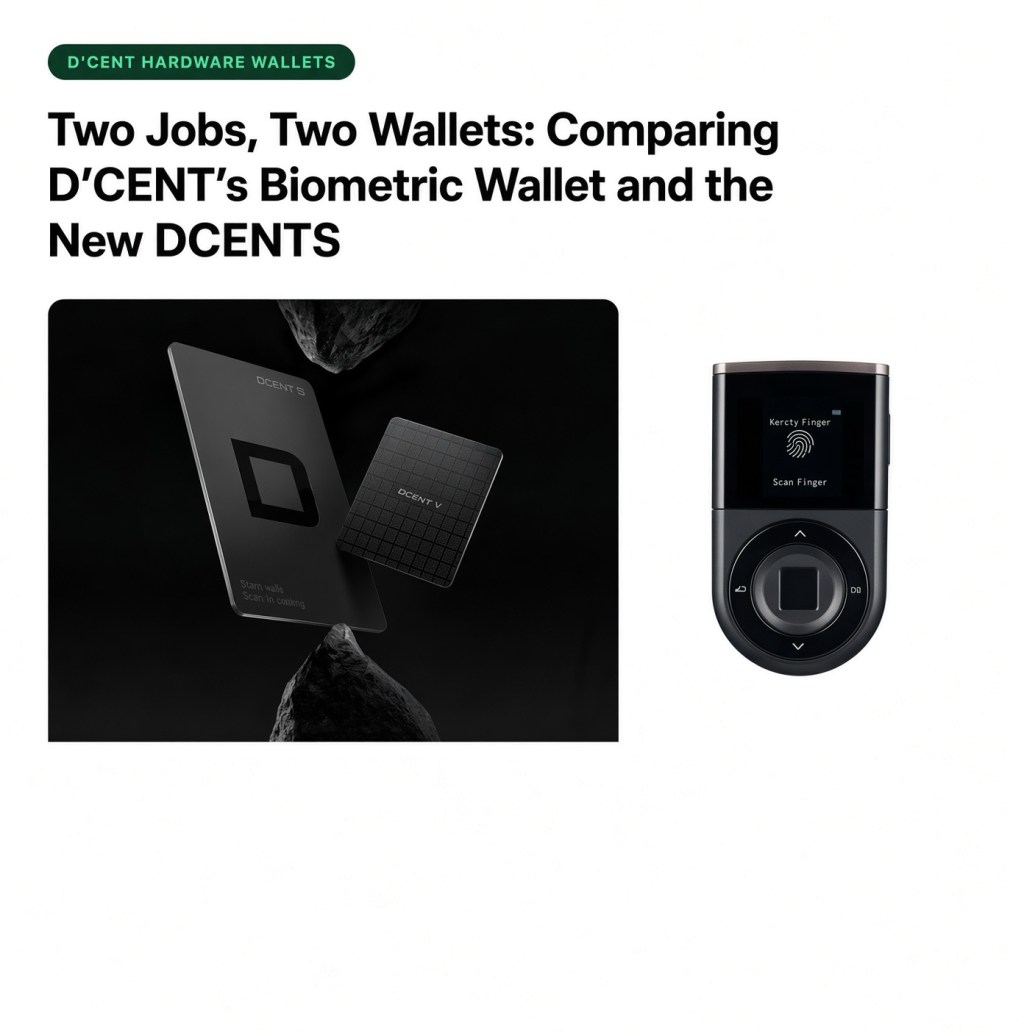
D’CENT has spent years arguing that hardware wallets should feel less like specialist instruments and more like tools ordinary people can actually live with. The company behind the brand, IoTrust of Seoul, launched what it called the world’s first biometric cryptocurrency hardware wallet in 2018 and has since built a user base measured in the millions across more than two hundred countries. In July 2026 it added a second hardware line that is not a cheaper clone of the first. DCENT S is a credit-card-thin, battery-free NFC wallet that ships with a dedicated recovery card instead of a paper seed phrase. The existing biometric device remains a small, screen-equipped unit with a fingerprint sensor, a battery, Bluetooth, and USB-C. Official marketing now treats the two products as complementary rather than competing: most people, the company suggests, will eventually carry one and store with the other. That framing is useful, but it is also a sales line. The honest comparison is more specific. The two wallets solve different anxieties, impose different daily rituals, and fail in different ways. Choosing between them is less about which device is “better” and more about which failure mode you are willing to live with.
The biometric wallet is the product that established D’CENT’s reputation. It is a compact device, roughly 77 by 43 by 11 millimeters and about 36 grams, with a small OLED screen, physical buttons, a capacitive fingerprint sensor, a 530 mAh battery, Bluetooth Low Energy, and USB-C on current units. Private keys are generated on the device and held inside a Common Criteria EAL5+ secure element. Transactions are proposed in the D’CENT mobile app, then reviewed on the hardware screen and approved with a fingerprint. Up to two fingerprints can be registered, and a PIN remains available as fallback. Recovery is conventional: a seed phrase written on the included recovery sheet and stored the traditional way. Official store pricing has fluctuated with promotions; the device has commonly been listed around 109 dollars on sale against a higher regular price, and older marketing materials still circulate figures closer to 139 dollars. What you buy is not merely a signer. You buy a small ritual of deliberation. You pick the device up, you look at an amount and an address on a screen that is not your phone, and you press your own fingerprint against a sensor that only you should be able to satisfy. For people who hold larger positions they rarely touch, that slowness is the point.
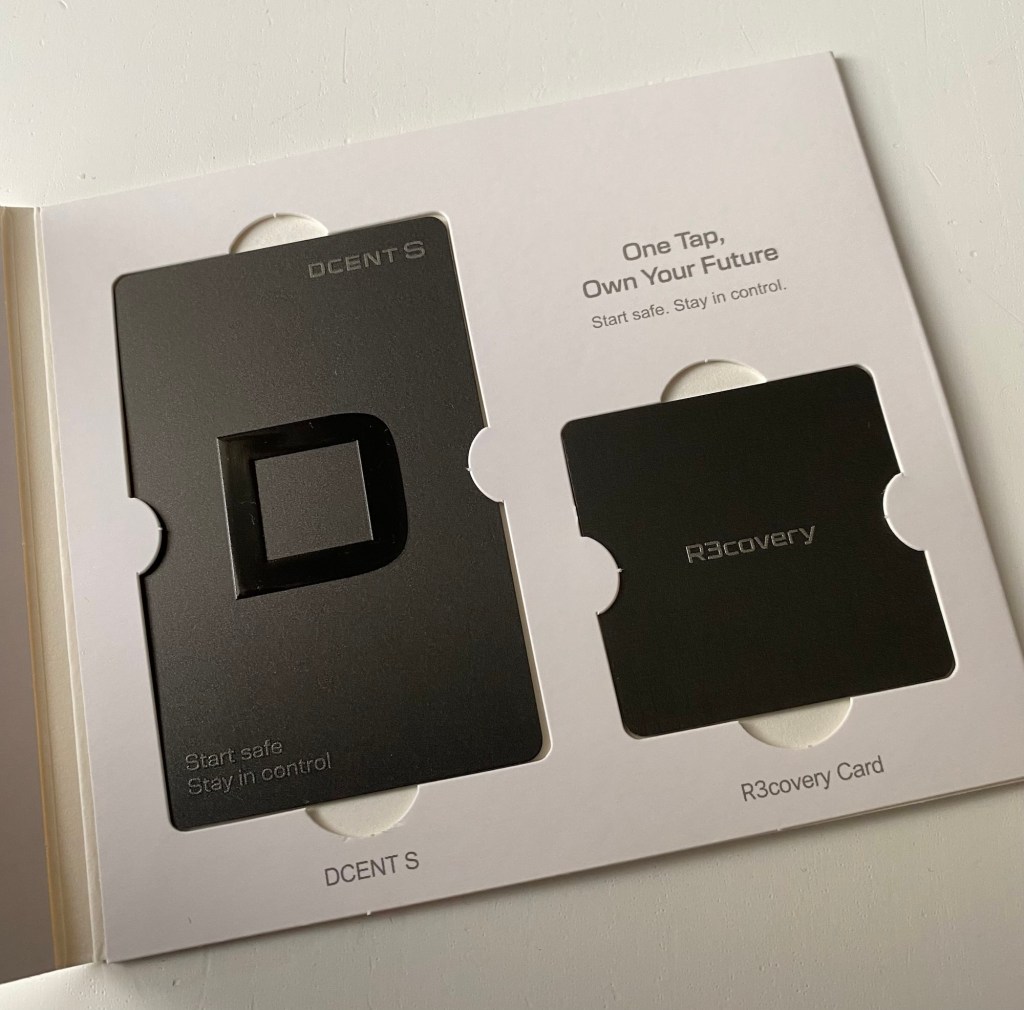
DCENT S is built around the opposite instinct. It is a card, 85.6 by 54 millimeters and 0.9 millimeters thick in published reviews of the form factor, thin enough to sit in a standard wallet slot. There is no battery, no charging port, no Bluetooth pairing, and no cable. Power arrives from the phone’s NFC field for the second it takes to sign. The kit in every box is not two identical cards. One card, the S, is the everyday signer. The other, branded R3covery, is a role-separated backup that stores an encrypted copy of the mnemonic inside its own secure element and cannot itself be used to send funds. Setup is designed to take about three minutes: install the app, tap the main card, tap the recovery card, set a PIN. The seed never appears as readable text on a screen or on paper unless a user deliberately chooses a more traditional path. If the main card is lost, stolen, or damaged, the owner taps the R3covery card to the app and restores to a new S in a few minutes. Official store pricing for the kit is 59 dollars. The comparison graphic that prompted this article lists a promotional 53 dollars against a 59-dollar store price, which is the kind of affiliate discount that comes and goes. Either figure is a fraction of the biometric device.
Security certifications look similar until you read the numbers. The biometric wallet’s secure element is certified EAL5+. DCENT S uses an EAL6+ chip, a higher evaluation assurance level of the same family of bank- and passport-grade silicon. Higher EAL is not a magic shield against every attack, and marketing that treats the increment as a complete story should be treated with the usual skepticism. What it does indicate is a more rigorous evaluation of the chip’s resistance to physical and logical extraction. S also advertises IP69 dust and water resistance and an operating range from minus 30 to plus 50 degrees Celsius, which matters if the card lives in a pocket through rain, airports, and winter. The biometric device’s working range is narrower, 0 to 40 degrees, and it is an electronic object with a battery and a screen. Both products generate keys offline, keep them inside the secure element, and sign so that the private key never leaves the chip. Both talk to the same mature D’CENT application, which now includes pre-sign simulation through Blockaid and an in-app assistant that tries to catch missing destination tags and similar human errors. Neither product has a public history of a successful extraction of keys from the hardware itself. IoTrust has repeated the “zero security breaches since 2018” line across both lines. That claim is about the company’s record, not a mathematical proof that a particular card cannot be attacked. It is still relevant context for a brand that has been shipping biometric hardware for eight years.
The backup models are the deepest philosophical split. The biometric wallet asks you to do what hardware wallets have asked people to do since the beginning: write words, hide the paper, hope you never need it and that nobody else finds it. That method is battle-tested. It is also the step at which many first-time self-custody users freeze, photograph the phrase, lose the phrase, or store it next to the device. DCENT S tries to remove the paper from the critical path. The mnemonic still exists; it is simply sealed into a second piece of silicon that you can keep in a different building, with a family member, and with its PIN stored separately from the card. Official copy is explicit that the two products are independent wallets. The S is backed up by the R3covery card. The biometric wallet is backed up by its recovery phrase. Neither device backs up the other. You set them up separately and manage them separately. That independence is easy to miss in a comparison table and important in practice. Buying both does not give you a mirrored pair. It gives you two distinct vaults with two distinct recovery stories.
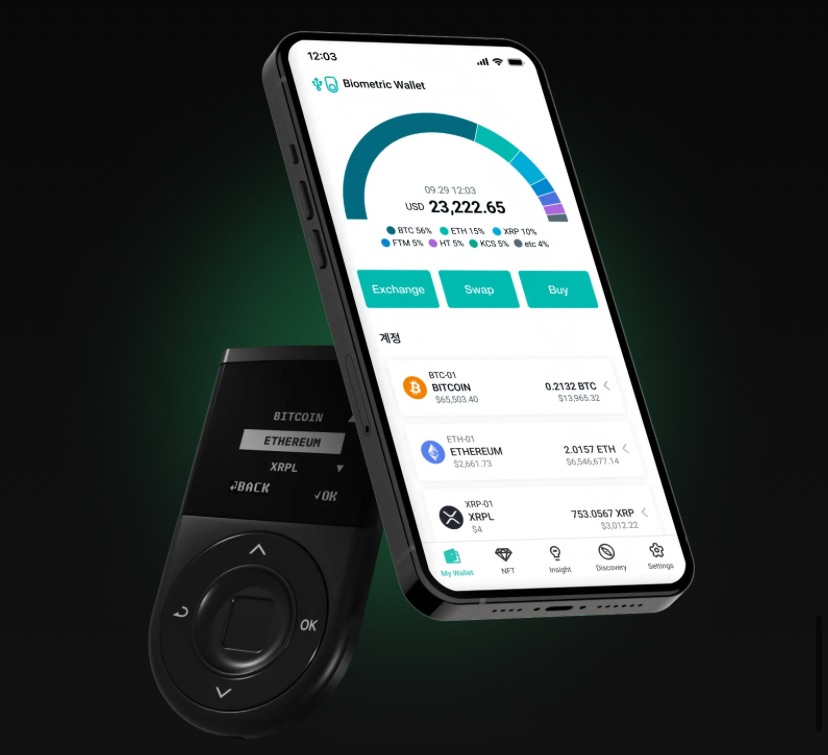
Form factor changes behavior more than spec sheets admit. A card that needs no charge will be in the wallet you already carry. A device with a screen and a fingerprint sensor will spend most of its life in a drawer, a safe, or a Faraday sleeve, and that is not a criticism. People treat objects according to how annoying they are to produce on demand. NFC tap-to-sign is fast once the phone and card cooperate. It is also dependent on a phone that has working NFC and on an app that is available when you need it. The biometric wallet can talk over Bluetooth or USB and shows the transaction on its own display, which is the classic hardware-wallet answer to the question “what if my phone is lying to me?” S answers that question in software: you review in the app, Blockaid simulates, then you tap. For everyday amounts that is a reasonable trade. For a transfer that represents years of savings, many experienced holders still want a second screen that is not the same glass they use for email. That is a preference, not a theorem, but it is a preference with a long history in this industry.
Asset coverage is no longer a decisive difference. Both lines now advertise on the order of 100 networks and thousands of tokens, with Bitcoin, Ethereum, XRP, Stellar, and a long tail of EVM and non-EVM chains in the same application. S marketing emphasizes that new chains can be added without a firmware update on the card, which is a practical advantage if you collect odd networks. The older All-in-One card that D’CENT sold before S was more narrowly an EVM-oriented product. S is the company’s attempt to put full multi-chain coverage into the card form. The biometric wallet already lived in that broader world. If your portfolio is Bitcoin plus a handful of majors, either device will hold it. If you live in XRP trust lines, obscure EVM tokens, and the next chain that launches next month, confirm the current supported list rather than trusting a headline number, because those lists move.
Price is the easiest comparison and the least interesting one if you ignore what the price is buying. At roughly 59 dollars the S kit undercuts almost every serious hardware wallet on the market, including D’CENT’s own flagship. You are paying for a signer and a physically separate backup, not for a screen, a battery, or a biometric sensor. The biometric device costs more because it is a small computer you can interrogate with your eyes and your fingerprint. Anyone who treats the cheaper card as “the same security for less money” is collapsing two different user experiences into a single number. Anyone who treats the expensive device as automatically safer because it costs more is making the opposite mistake. Cost tracks features and bill of materials. Risk tracks how you store the backup, how often you actually verify an address, and whether you will still be able to find the device in five years.
Who should buy which wallet becomes clearer once you stop looking for a winner. Buy DCENT S if you want self-custody to collapse into something you already do: open a wallet, pull out a card, tap, put it back. It is the better everyday-carry object, the better travel object, and the gentler introduction for someone who has been leaving coins on an exchange because seed phrases feel like a ritual from another century. It is also the better answer for people who know they are sloppy with paper. A recovery card you can keep in a bank box or with a relative is not immune to loss or coercion, but it removes the specific failure of a damp notebook and a faded pen. Buy S if you move funds with some regularity, pay for things, bridge, or simply refuse to leave a 200-dollar gadget at home every time you leave the house. Buy it if you want the backup physically role-separated from the spending instrument, so that a stolen wallet card is not automatically a stolen fortune.
Buy the biometric wallet if your primary need is long-term storage of a position you do not want to casually produce in a café. The screen and the fingerprint create friction, and friction is a feature when the asset is large and the transaction is rare. You can register a second fingerprint, which some households use as a practical shared-access measure, with all the interpersonal complications that implies. You can charge the device, connect it by cable when Bluetooth is inconvenient, and read the destination on hardware before you approve. You accept the paper seed and the obligation to store it well. That is the older contract, and for vault capital it is still the contract many careful holders prefer. The biometric wallet is also the device that feels like a hardware wallet in the cultural sense: a thing you pick up, look at, and authorize with your body.
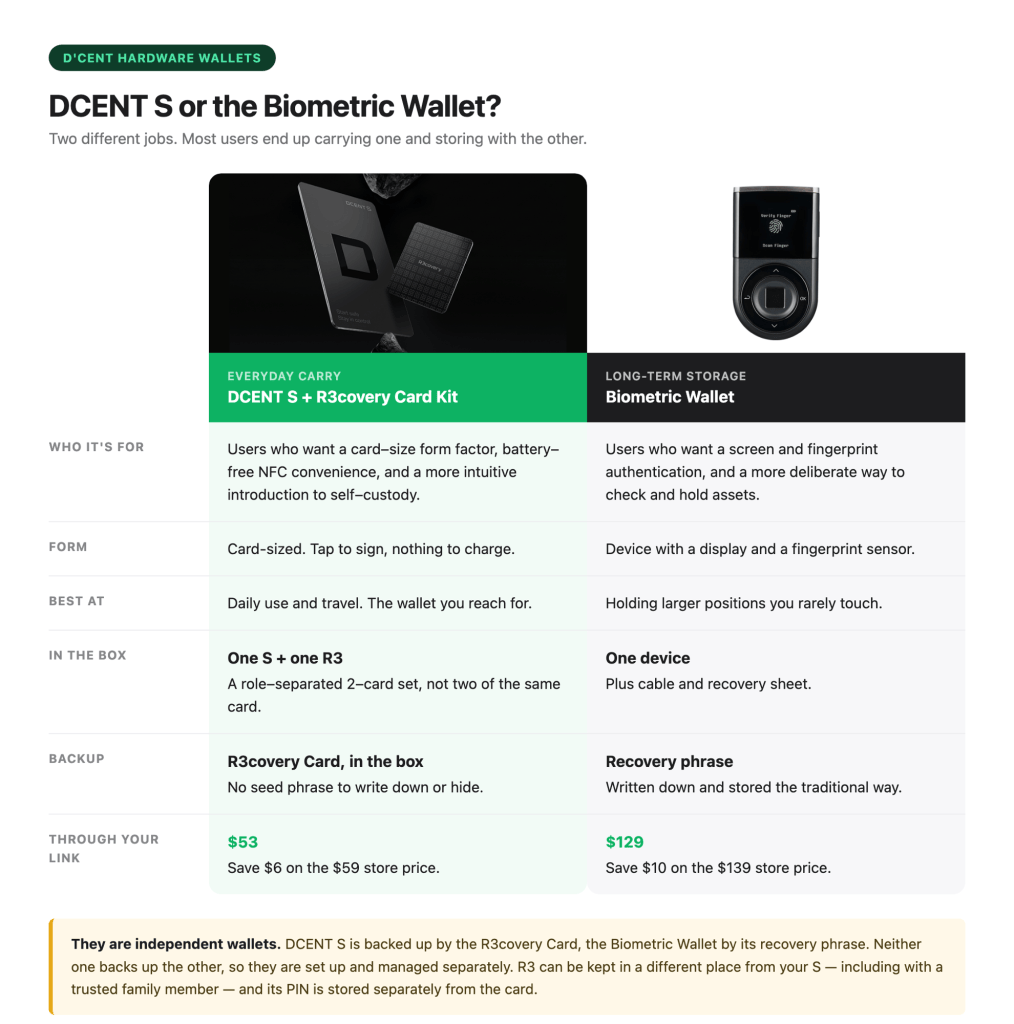
The most coherent reading of D’CENT’s own comparison is that many users should eventually own both, not because the company wants two invoices, but because the jobs really are different. A spending balance that lives on a card in a physical wallet and a reserve balance that lives on a fingerprint device in a safe is a cleaner architecture than one gadget asked to be both convenient and solemn. Because the products do not back each other up, that architecture only works if you treat them as separate systems: separate setup, separate recovery, separate hiding places. The R3covery card can sit with a trusted family member while the S stays in your pocket; its PIN should not travel in the same envelope. The biometric recovery sheet should not sit in the same drawer as the device. Those sentences are dull. They are also where most losses actually happen.
A light personal view, after looking at the official pages and the comparison the company itself now publishes, is that DCENT S is the more important product of the two for the next few years, not because it is more secure in the abstract, but because it attacks the reason people still do not self-custody. The bottleneck has not been a shortage of EAL certifications. The bottleneck has been the feeling that holding keys is a part-time job with a 24-word exam attached. A card that never needs charging and a backup that is another card is a serious attempt to make the job smaller. The biometric wallet remains the more complete instrument for anyone who wants to see a transaction with their own eyes on a dedicated display and bind approval to a fingerprint. It has not been made obsolete. It has been given a partner with a different personality.
Limitations should be named without drama. DCENT S has no screen, so your defense against a compromised phone is the app’s simulation layer, your own habit of checking addresses, and the fact that the key still cannot be extracted by the phone. NFC can be finicky across phone models. A lost main card is recoverable only if the R3covery card and its PIN still exist; lose both and you are in the same position as anyone who lost a seed. The biometric wallet has a battery that will one day swell or die, a screen that can fail, and a seed phrase that is only as good as the place you put it. Fingerprints are convenient and not a substitute for the PIN when an attacker can compel a finger. Firmware and app trust still matter on both products; these are not air-gapped machines in the strictest sense. D’CENT is a Korean vendor with a long shipping record and a closed hardware stack. That is a different trust model from a fully open-source device, and buyers who care about inspectability should weigh that on purpose rather than discover it later.
The practical decision can be reduced without becoming a table. If you are moving coins off an exchange for the first time and you want the object to disappear into a sleeve of cards you already own, the S kit is the rational first purchase. If you are parking a large, infrequently touched position and you want the psychological and operational weight of a screen and a fingerprint, the biometric wallet is the rational first purchase. If you already know you will do both things — spend a little, hoard a lot — the company’s own line is the right one: they are two jobs. Carry one. Store with the other. Set them up as strangers to each other. That is less romantic than a single perfect device, and more like how people actually keep valuable things in the physical world.
If you want to get one of these wallets you can use our link to grab a discount.
Read more hardware wallet reviews
- Ryder One crypto wallet review 2026
- OneKey Pro crypto hardware wallet review 2026
- My personal review of the ERA crypto hardware wallet
- My big personal review of the classic BitBox02 hardware wallet
rendite.cloud – your finance blog
Affiliate Links. If you get one of the products we might receive a commission.


Hinterlasse einen Kommentar